Welcome!

I'm glad you are here to read my blog. I pray your learn more about other cultures and life in general. God bless and keep you!

Monday, August 27, 2012

Almost Here!

http://edition.cnn.com/2012/08/26/world/asia/typhoon-bolaven/index.html

The following is from the link above.  So excited!


Tokyo (CNN) -- A massive typhoon crossed over Okinawa on Sunday, bringing winds more ferocious than even the typhoon-weary Japanese island has seen in decades.

Typhoon Bolaven, with wind gusts that reached as high as 259 kilometers per hour (161 mph), is the strongest to strike the region in nearly 50 years. And with a cloud field of 2,000 kilometers (1,250 miles), it is 20 times larger than Okinawa's length.

"It's been very, very severe," said storm chaser James Reynolds, who was on the northwestern coast of the island during the worst of the storm.
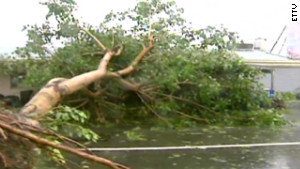
Typhoon makes landfall in Taiwan

Tree branches were flying through the air amid torrential rain, he said.

Speaking to CNN early Monday morning on Okinawa, Reynolds said, "It's been a long and rough night."

"The eye of the typhoon actually crashed ashore just after dark. ... Like the rest of the population we all just kind of holed up in the strong and sturdy buildings which make up Okinawa," he said.

The infrastructure on Okinawa is designed to withstand violent storms. "Everything's made of solid concrete," said Reynolds.

The last storm of this scale was Typhoon Naha in 1956.

At 3 a.m. Monday local time (2 p.m. ET Sunday), Bolaven had winds of 194 kilometers per hour, with gusts at 240 kilometers per hour, CNN International meteorologist Jennifer Delgado reported.

Bolaven could make landfall at the Korean peninsula on Tuesday morning, or potentially in South Korea on Monday night, Delgado said.

Isaac near hurricane strength; watch extends to Louisiana

In the meantime, rainfall totals in Okinawa could top 500 mm (20 inches) in 24 hours, said CNN International meteorologist Tom Sater.

Bolaven is "roughly the size of France to Poland in land mass," said Sater.

Time: Most destructive U.S. hurricanes

Storm surges were expected to be a major problem for Okinawa. More than 400,000 people in the area live at elevations less than 50 meters (164 feet).

"The large battering waves on both sides of Okinawa are going to be a threat to people living near the water," Reynolds predicted. "But I think the worst has passed now. The storm is moving away and unfortunately it's the people in the Korean peninsula who look like they've got to prepare for the incoming storm."

Taiwan, meanwhile, could be in for a pounding due to something called the Fujiwhara effect.

Typhoon Tembin made landfall in southern Taiwan a few days ago, and was expected to work its way toward Hong Kong. But Bolaven, which is much stronger, has stopped Tembin's movement toward Hong Kong and has been spinning it around. Tembin is likely to make a second landfall in southern Taiwan, also on Tuesday morning.

"As Typhoon Bolaven moves northward towards the Yellow Sea, it will drag Tembin toward the China coast very near Shanghai," said Sater. "That's an amazing change in direction."

Typhoon

Well tomorrow is the big day.  The Korean peninsula will be flooded with rain in heavy waves.  The Koreans are not very excited about it and trying to make sure everyone is aware.  I'll be wearing rainboots to work.  I'm pretty happy though for tomorrow to arrive.  I love rain and the lullaby rain can resonate.

Friday, August 24, 2012

Typhoon Bolaven? Oh that explains...!

Copied and pasted an email below. Finally I know why we just got three days of rain. We hopefully will get a break over the weekend, but more rain is to come for sure. We are only going to get rain here...

The U.S. Embassy in Seoul is transmitting the following information as a public service to U.S. Citizens in the Republic of Korea.

According to the Joint Typhoon Warning Center (JTWC), Typhoon Bolaven is moving towards the Korean peninsula and is expected to make landfall on the Peninsula around the afternoon of August 27th and will continue to move north bringing heavy rain of 50-100 mm. and strong winds. A typhoon warning is in effect.

For specific information on the storm, please refer to the Korean Meteorological Administration for further information. http://web.kma.go.kr/eng/index.jsp

Strong winds associated with typhoon may cause damage by blowing down trees, fences, TV antennas, etc. Property can be damaged by loose objects being blown around by these strong winds and by driving rains entering through joints around windows doors. In some areas tropical storm may cause local landslides, flooding and wave damage.

Typhoons can cover areas of up to 500 miles (800 km) in diameter and generate winds up to 180 miles (290 km) an hour. The typhoon season in East Asia Pacific runs from May through October, with most activity from July to September. Typhoons that hit the region are often accompanied by damaging high tides. Persons living in areas close to the ocean are especially at risk. Landslides are also a serious concern during periods of heavy rain. A typhoon advisory (Jui) will be issued when the weather can cause damage. Typhoon warnings (kyungbo) will be issued when heavy widespread damage is expected due to the weather. For English-language information on the typhoon situation on the Korean peninsula, please refer to Armed Forces Network FM at 102.7, and/or TBS English FM 101.3.

Being prepared for a typhoon means keeping informed on the progress and severity of the storm, and taking some common-sense precautions to minimize the problems a typhoon may cause for you. National Emergency Management Agency (NEMA) of the Republic of Korea provides safety guidelines on preparing for a typhoon. For these safety tips, please refer to http://eng.nema.go.kr/sub/cms4/4_1.asp

In anticipation of typhoon weather conditions, you should take the following actions:
1. Inspect the general condition of your quarters. Look for loose items, broken or cracked windows and doors and windows that will not latch securely. Request repairs for unsafe items and remove loose items from porches and patios.
2. Inspect your first aid kit to ensure it is complete.
3. Check to make sure you have sufficient candles, matches, lanterns, flashlights, batteries, etc. to provide adequate emergency lighting.
4. Close and lock all exterior doors, shutters and windows.
5. Check to see that you have a supply of non-perishable foodstuff and potable water set aside for an emergency.
6. Secure or move indoors all items outdoors such as toys, cookers, bicycles, balcony furniture, grills, plants, and anything moveable.
7. Keep your radio tuned to RADIO AFN (AM1440/FM102.7) for tropical storm announcements.
8. Set your freezer to the coldest temperature setting to minimize spoilage if the electric power is cut off.
9. Gather buckets, towels, rags and mops to absorb rainwater that may be blown into your quarters by the wind.
10. If water leaks in around the windows and doors, roll up rugs and place them on top of beds or tables to avoid water damage.
11. If the storm becomes very severe, move your family into a hallway or an area where there is the least exposure to external glass windows.

Continue to monitor local radio and other media, and the National Weather Service to be aware of weather developments. Minor tropical storms can develop into hurricanes or typhoons very quickly, limiting the time available for a safe evacuation. Inform family and friends of your whereabouts and remain in close contact with your tour operator, hotel staff, transportation providers (airlines, cruise lines, etc.), and local officials for evacuation instructions during a weather emergency.

We strongly encourage U.S. citizens to enroll with the nearest U.S. embassy or consulate through the Department of State's Smart Traveler Enrollment Program (STEP) website. By enrolling, you will receive the Embassy's most recent security and safety updates during your trip. Enrollment also ensures that you can be reached during an emergency. While we will do our utmost to assist you in a crisis, be aware that local authorities bear primary responsibility for the welfare of people living or traveling in their jurisdictions.
Additional information on hurricanes and storm preparedness can be found on the Department’s "Hurricane Season - Know Before You Go" webpage. You can get updated information on travel from the Department of State by calling 1-888-407-4747 within the United States and Canada or, from outside the United States and Canada, 1-202-501-4444.

Embassy Contact Information:

American Citizen Services
U.S. Embassy Seoul
32, Sejongno, Jongno-gu
Seoul 110-710, Korea

- or -

American Citizen Services
U.S. Embassy, Seoul
Unit #15550
APO AP 96205-5550

Tel: 02-397-4040 (Passport Inquiry line)
Tel: 02-397-4114 (All other services)
Fax: 02-397-4080
DSN: 721-4114
English: http://www.asktheconsul.org/
Korean: http://www.usavisas.org/
E-mail: seoulinfoacs@state.gov

Alternatively, you may unsubscribe from the embassy website at http://www.asktheconsul.org/ (enter your email address and click on "unsubscribe"). Or, you may send an email to:
leave-seoulacs@mh.databack.com.

End of text.

Thursday, August 23, 2012

New Vocabulary

Vocabulary Word: Bunch.

Fun Fact to make kids happy... youtube video of the Brady Bunch theme song. Ah! It is stuck in my head!

~~~~~~~~~~~~~~~~~~~~~~~~~~~~~~~~~~~~~~~~~~~

*snicker snicker* We had a vocabulary word, "squeeze," with the definition being "to press firmly." The picture was of a lemon being squeezed. What did I put my students through? Demonstrating by squeezing random stuff around the classroom one student at a time. They were laughing so hard that talking wasn't an option.

Tuesday, August 21, 2012

Flexible - A Way of Life

So when I thought I needed to be flexible at the start of this semester, I didn't truly know the full impact such a decision would make.  I had prepared for switching from the blue team to the red team.  I had prepared the students for switching classrooms.  Everything was approved and set in stone.  Flexible moment!  Today was the first day teaching the new classes and new students.  The first class was spent redirecting students around to their proper locations when a student told me my classroom was not the red classroom, but blue.  I explained that because my office is in this classroom, and I am now teaching red, that this was the red classroom.  Nope.  Turns out I am still a blue team teacher and this classroom is indeed blue and I am teaching the same classes as before.  Instead of teachers moving around, the students were mixed up with the smartest students being sent to the blue classroom.  I can't complain.  I like the arrangement.  I just would have liked to have known about it a day before instead of 10 minutes into class.  This is what it means to be flexible.

Monday, August 20, 2012

Start of Second Semester - In August

Today is the first day of second semester.  I had wondered if we would start this week or next week.  For me, I had too much spare time to not be grateful for school to be going again.  However with last minute changes to our schedules, I find myself not prepared for the start of this semester.  Just like every semester before.  This seems to be a common theme here.  A teacher rarely learns for sure which classes she is teaching until a week before or the week that classes begin.  Hoping to keep on the ball so that my students get the best education possible.

This includes decorating the classroom.  I have new posters and material for the classroom thanks to some other foreign teachers who live nearby.  They are moving to Seoul and left many of their teaching things here.  They kindly allowed me to acquire some of those things.  Eager to get them put up tonight.  Start classes tomorrow on the right foot.  The classes I teach today are the last time I will have these students.  Tomorrow I start all new classes and students.

Friday, August 17, 2012

Flexible - Best Advice Ever

The best advice I have ever gotten before and since arriving in South Korea was to be flexible.  If you think you are already flexible, then try to be even more flexible.  Otherwise you will find yourself saying jinjja (진짜) more often than not.

In Korea, it is a part of their culture to not make plans or decide something until the day before or the day of.  If they do, then it generally changes several times until that day of the supposed event ends.  For example, getting ready for this coming semester, I knew that they planned to have teachers switch around for the International Sophomore Culture class.  I avoided making lesson plans for that class until I knew what was going to be happening.

A very smart Teacher Willis called in Teacher Oh to let us know the plan this last week.  Good thing to since the school decided to change all of our classes.  We would have found out Monday, the day of class, if it hadn't been for that foresight.  We know that more changes will be made somewhere, but we are hopeful that the big ones are known.  If not, then we will adapt on our feet as need be.  Why?  Because we are Foreign Teachers and are good at what we do.